
Introduction
Modafinil and methylphenidate are often discussed in the same breath, especially among people looking to improve alertness, focus, or daytime performance. In the UK, both drugs sit at the intersection of medicine, regulation, and public curiosity—yet they are fundamentally different in how they work, how they are prescribed, and how they affect the brain. This article provides a clear, evidence-based comparison of modafinil vs methylphenidate in the UK, written for general readers who want accurate information without medical jargon. Drawing on clinical observations and regulatory guidance, we explore how these drugs differ in mechanism, effects, risks, and legal status.
What is modafinil?
Modafinil is a wake-promoting agent originally developed to treat narcolepsy and other sleep-wake disorders. In the UK, it is most commonly prescribed for narcolepsy, though it is also widely discussed for off-label cognitive and alertness-related uses.
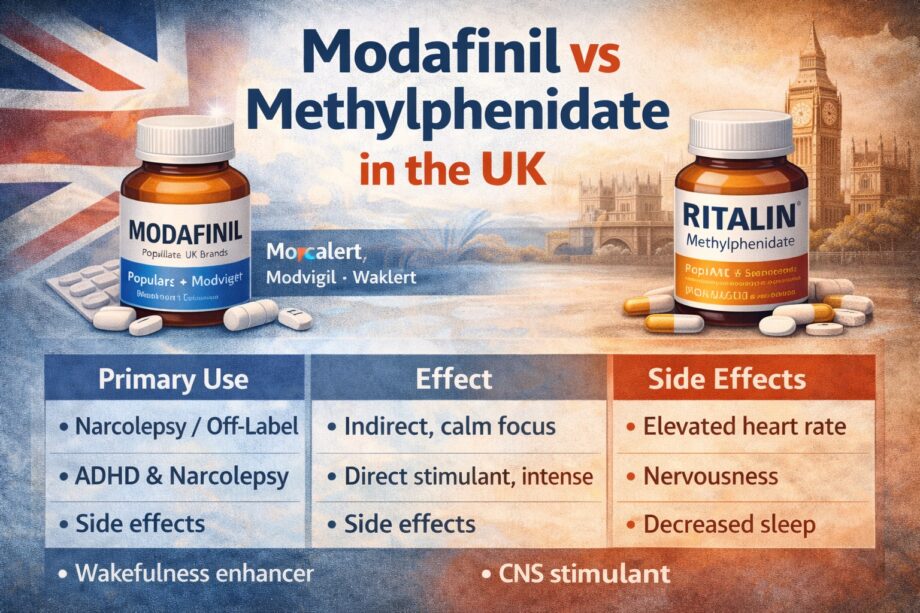
Unlike classic stimulants, modafinil does not directly flood the brain with dopamine. Instead, it subtly increases wakefulness by modulating dopamine transporters and activating orexin and histamine pathways. This mechanism explains why many users describe it as producing “calm focus” rather than nervous energy.
For UK-specific access, availability, and legal context, readers often begin with Modafinil in the UK.
What is methylphenidate?
Methylphenidate is a central nervous system stimulant best known under brand names such as Ritalin and Concerta. It is primarily prescribed for attention-deficit hyperactivity disorder (ADHD) and, less commonly, narcolepsy.
Pharmacologically, methylphenidate increases dopamine and norepinephrine levels by blocking their reuptake. This produces a stronger, faster stimulant effect compared with modafinil, which can be beneficial for ADHD symptoms but also raises the risk of side effects.
In UK clinical practice, methylphenidate is tightly controlled and usually initiated by specialist psychiatrists.
Mechanism of action: subtle vs direct stimulation
The core difference between modafinil and methylphenidate lies in how they stimulate wakefulness.
Modafinil acts indirectly. It enhances alertness without strongly activating the brain’s reward pathways, which is why dependence risk is considered lower. Many clinicians note that patients remain mentally clear and emotionally stable, even during prolonged use.
Methylphenidate, by contrast, is a direct stimulant. Its effects are more pronounced and immediate, which can improve attention but also lead to jitteriness, appetite suppression, or rebound fatigue as the drug wears off.
Clinical observations and real-world use
In clinical settings, physicians often observe that modafinil is better tolerated in adults who need sustained alertness rather than rapid stimulation. Shift workers, long-distance drivers, and patients with sleep disorders frequently report improved vigilance without emotional highs or crashes.
Methylphenidate tends to be more effective for core ADHD symptoms such as impulsivity and hyperactivity. However, clinicians also see higher discontinuation rates due to anxiety, sleep disruption, or cardiovascular concerns.
These differences explain why the two drugs are rarely interchangeable, despite being compared online.
Cognitive effects and productivity
From a cognitive standpoint, modafinil is often described as enhancing executive function—planning, working memory, and sustained attention. Users report feeling more organized rather than more “driven.”
Methylphenidate can increase task initiation and motivation, but at the cost of greater physiological stimulation. For some people, this translates into productivity; for others, it leads to restlessness or over-focus.
In discussions about Smart drugs, modafinil is frequently grouped with compounds that prioritize cognitive endurance rather than raw stimulation.
Modafinil vs Methylphenidate: side effects and tolerability
No medication is risk-free, and both drugs have distinct side-effect profiles.
Common modafinil side effects include:
- Headache
- Nausea
- Reduced appetite
- Insomnia if taken too late
Common methylphenidate side effects include:
- Increased heart rate and blood pressure
- Anxiety or irritability
- Appetite suppression
- Sleep disturbances
Clinically, modafinil is often described as “forgiving” in dosing, whereas methylphenidate requires closer titration and monitoring.
Dependence and abuse potential
One of the most important differences concerns dependence risk.
Methylphenidate is classified as a controlled stimulant in the UK due to its abuse potential. Long-term use requires regular review, and abrupt discontinuation may cause withdrawal symptoms.
Modafinil, while still prescription-only, has a lower abuse profile. This is supported by its pharmacology and by post-marketing surveillance data cited in regulatory reviews.
For readers comparing stimulants, Adderall is often mentioned as another point of reference, though its legal status and risk profile differ again.
Legal and regulatory status in the UK
In the UK, both modafinil and methylphenidate are prescription-only medicines.
- Modafinil is regulated under UK medicines law and approved mainly for narcolepsy.
- Methylphenidate is additionally classified as a controlled drug under the Misuse of Drugs Regulations, reflecting higher abuse risk.
Regulatory guidance from the UK Medicines and Healthcare products Regulatory Agency (MHRA) aligns with broader European evaluations by the European Medicines Agency (EMA), which has issued safety reviews on stimulant medications:
- EMA assessment on modafinil safety: https://www.ema.europa.eu/en/documents/referral/modafinil-article-31-referral-annex-i-ii-iii_en.pdf
For pharmacological context, the U.S. National Institutes of Health (NIH) provides neutral overviews of stimulant and wake-promoting agents:
- NIH overview: https://www.ncbi.nlm.nih.gov/books/NBK538131/
Modafinil brands and formulations
One practical consideration for UK users is the availability of different generic formulations. These vary slightly in excipients, release profile, and cost.
Commonly discussed options include:
These products are often compared in discussions of Modafinil brands and Modafinil price, especially when considering long-term use.
Alternatives sometimes discussed
Some readers exploring modafinil vs methylphenidate also look into alternatives, including:
- Atomoxetine (a non-stimulant ADHD medication)
- Bupropion (an antidepressant with stimulant-like properties)
- Flmodafinil (a research analogue, not fully approved)
These compounds differ substantially in evidence base and regulatory status, and none should be considered interchangeable without medical guidance.
Which is “better”?
There is no universal winner in the modafinil vs methylphenidate debate.
- Modafinil tends to suit people who need sustained alertness with fewer emotional side effects.
- Methylphenidate remains the first-line option for many ADHD patients due to its robust efficacy.
In practice, the “better” choice depends on diagnosis, health history, and tolerance—not on online popularity.
Conclusion
Modafinil and methylphenidate may both improve wakefulness and focus, but they represent two very different pharmacological philosophies. One emphasizes subtle regulation of alertness; the other relies on direct stimulation.
Understanding these differences is essential for anyone navigating treatment options or researching cognitive enhancers in the UK. Informed decisions begin with accurate information—not assumptions based on surface similarities.
Medical disclaimer
This article is for informational purposes only and does not constitute medical advice. Always consult a qualified healthcare professional before starting, stopping, or changing any medication.
